
Yesterday, I shared rhlifecyclesummary.sh—a quick CLI tool designed to query official support dates for core Red Hat products. While command-line tools are great for quick terminal queries or automation scripts, visually mapping lifecycle timelines across an entire enterprise stack requires a cleaner, interactive experience. The goal was to keep the application fast, stateless, and low-footprint. And it was purposefully built to help and support my customers and Red Hat field teams to react faster to EOL across multiple products that customers use.
- Link to Red Hat Product Lifecycle Dashboard.
- Latest and more details can be found in my Git repository.
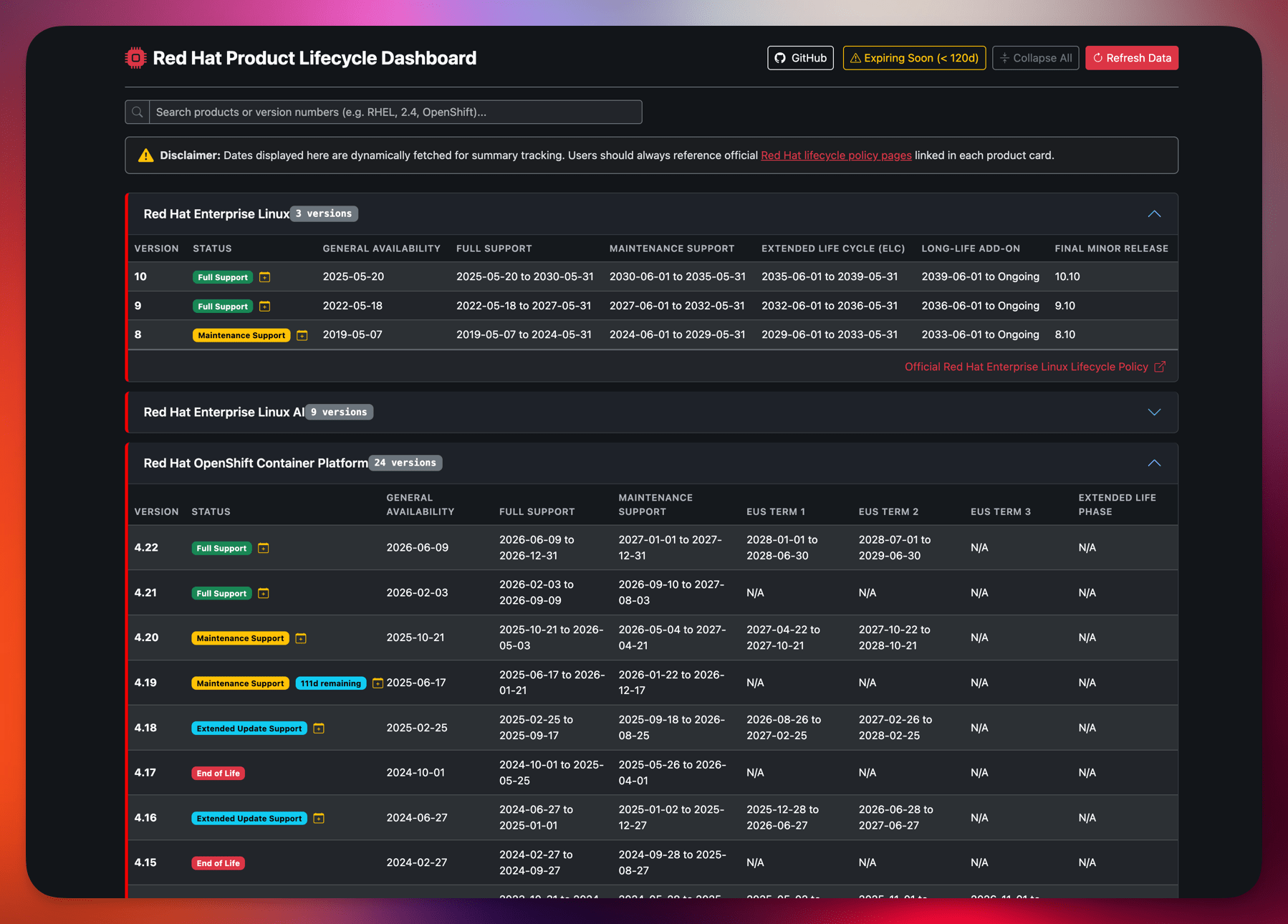
To solve this, I built Red Hat Lifecycle Dashboard: a lightweight application that dynamically parses Red Hat’s Product Life Cycles API and presents an enterprise-ready dashboard that informs you when your product is nearing EOL <120/90/60/30 days. You have the ability to add product notifications into your calendar to get your started on planning for upgrades as the dates are getting closer.
🛠️ Architecture & Tech Stack
- Backend: Built with Python 3.12 and FastAPI. It asynchronously queries the Red Hat Product Life Cycles API using
httpxand dynamically normalizes inconsistent lifecycle schemas across product lines. - Frontend: A responsive dark-mode UI built with Bootstrap 5.3 and Bootstrap Icons. It features collapsible accordion cards, live version counts, and instant client-side search filtering.
- CICD Pipeline: GitHub actions for release and managing container images
- Hosted PaaS on render.com.
- CDN/SSL/DNS with cloudflare
- Containerization: Configured for rootless execution using a multi-stage Dockerfile and deployed seamlessly with Podman.
- Local development: Tilt & podman compose
- Monitoring: uptimerobot & cron-job.org
📦 Tracked Products
Out of the box, the dashboard aggregates real-time lifecycle feeds for:
- Core OS & Edge: RHEL, RHEL AI, Edge Manager, MicroShift
- Containers & AI: OpenShift Container Platform (OCP), OpenShift AI (RHOAI), Red Hat Quay
- Automation & Middleware: Ansible Automation Platform (AAP), Red Hat build of Keycloak, Red Hat SSO, JBoss EAP, Data Grid
- Others: MicroShift, Edge Manager, OpenStack, OpenStack on OpenShift
Every product card includes direct links back to official Red Hat policy pages for formal SLA verification.
🚀 Quickstart & Deployment
The application is automatically built and published from GitHub directly to Quay.io.
Option 1: Run Pre-built Image via Podman / Docker
# Pull and run directly from Quay.io
podman run -d -p 8881:8881 --name rh-dashboard quay.io/jgoh/rhlifecyclesummary:latest
Access the UI at http://localhost:8881.
Option 2: Deploy with podman-compose
Clone the repo and spin up the service:
git clone https://github.com/explicitworkload/rhlifecyclesummary.git
cd rhlifecyclesummary
podman-compose up -d --build
🤝 Open Source & Contributions
The project is fully open source. If there are additional Red Hat products you’d like to see included, feel free to open a Pull Request or reach out directly!
- GitHub Repository: github.com/explicitworkload/rhlifecyclesummary
- Container Registry:
quay.io/jgoh/rhlifecyclesummary:latest - Maintainer: John ([email protected])
